Light pole spacing and coverage are the core of qualified outdoor lighting design, directly determining roadway uniformity, pedestrian safety, glare control, and energy efficiency. Professional layout follows standardized height-to-spacing ratios defined by IESNA, AASHTO, and AS/NZS 1158 lighting codes. Correct pole spacing eliminates dark zones, avoids over-illumination waste, and keeps public lighting assets fully code-compliant for long-term operation.
Key Takeaways
- Standard Spacing Ratio: Maintain a spacing-to-mounting-height ratio of 2.5 to 4 times the pole height to ensure seamless overlapping light cones and eliminate blind spots.
- Optical Distribution Selection: Select the correct IES lateral light distribution pattern (Type I to Type V) based on the target area’s Aspect Ratio to mitigate glare and upward light output (BUG rating control).
- Code Compliance: Always verify pole specifications against local civil engineering standards such as AASHTO (American Association of State Highway and Transportation Officials) or EN 40 structural requirements.
Understanding Lighting Pattern Types
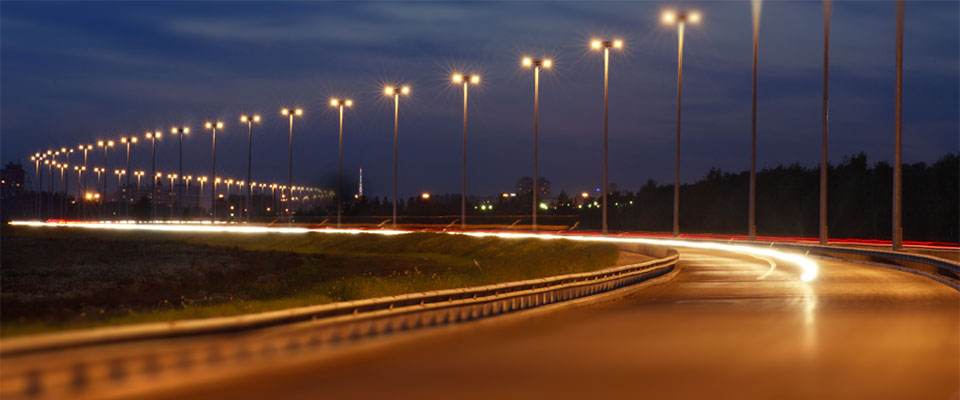
Lighting pattern types show how a fixture spreads light in an area. Each type is made for different needs for light pole spacing and coverage. Companies like Morelux make steel poles and fixtures to fit these patterns. They also follow international standards.
Type I
Type I lighting makes a long, thin pattern. It works best for walkways, paths, and narrow roads. The light spreads the same on both sides of the pole. Installers put poles in the middle or at the edge of the path. The best spacing is about 2.5 to 3 times the pole’s height. This setup gives good coverage and stops dark spots.
Type II
Type II lighting makes a wider pattern than Type I. It is good for wide walkways, small roads, and parking lot edges. The light spreads out at a 25-degree angle from the pole. Poles go at the side of the area. The spacing is usually 2.5 to 3 times the pole’s height, or about 25 to 45 meters for city roads. Morelux Steel Poles can be changed for these uses. You can pick the pole height and arm style.
Type III
Type III lighting makes a broad pattern at a 40-degree angle. This type is used for regular roads and parking areas. Installers put the fixture at the side of the road or lot. The area should not be wider than 2.75 times the mounting height. This keeps the lighting even and safe.
Type IV
Type IV lighting makes a half-circle pattern at a 60-degree angle. It works well for wide roads, parking lots, and places next to walls or buildings. Installers put the fixture at the side. The area should not be wider than 3.7 times the mounting height. Morelux sells custom steel poles with different heights and arms for these needs.
Type V
Type V lighting sends light in a full circle. This pattern is good for big open areas, intersections, and center islands. Installers put the fixture at or near the center of the area. The light spreads the same in all directions. This gives balanced coverage. It is common in large parking lots and public spaces.
Type VS (Square)
Type VS lighting spreads light in all directions but makes a square shape. This type is good for roads, intersections, and big parking areas where you want a clear edge. Installers put the fixture at or near the center. The square pattern helps control where the light goes. This cuts down on extra light outside the area.
| IES Type | Lateral Light Distribution | Aspect Ratio Boundary (Width / Mounting Height) | Primary Applications | Recommended Spacing Range |
| Type I | 15° Narrow Bi-directional | Width $\le$ 0.5 MH | Walkways, bike paths, narrow center medians | 2.5 to 3.0 $\times$ MH |
| Type II | 25° Narrow Asymmetric | 0.5 MH $\le$ Width $\le$ 1.0 MH | Residential streets, alleys, perimeter sidewalks | 2.5 to 3.5 $\times$ MH |
| Type III | 40° Broad Asymmetric | 1.0 MH $\le$ Width $\le$ 1.75 MH | Conventional multi-lane roadways, commercial parking lots | 3.0 to 4.0 $\times$ MH |
| Type IV | 60° Semicircular Forward-Throw | 1.75 MH $\le$ Width $\le$ 2.75 MH | Wide arterials, building perimeters, site boundaries | 2.5 to 3.0 $\times$ MH |
| Type V | 360° Omnidirectional Circular | N/A (Symmetrical) | Intersections, large open parking areas, town squares | 3.5 to 4.5 $\times$ MH |
| Type VS | 360° Omnidirectional Square | N/A (Symmetrical Square) | Commercial lot grids where sharp cutoff lines are required | 3.5 to 4.5 $\times$ MH |
Light Pole Spacing Factors
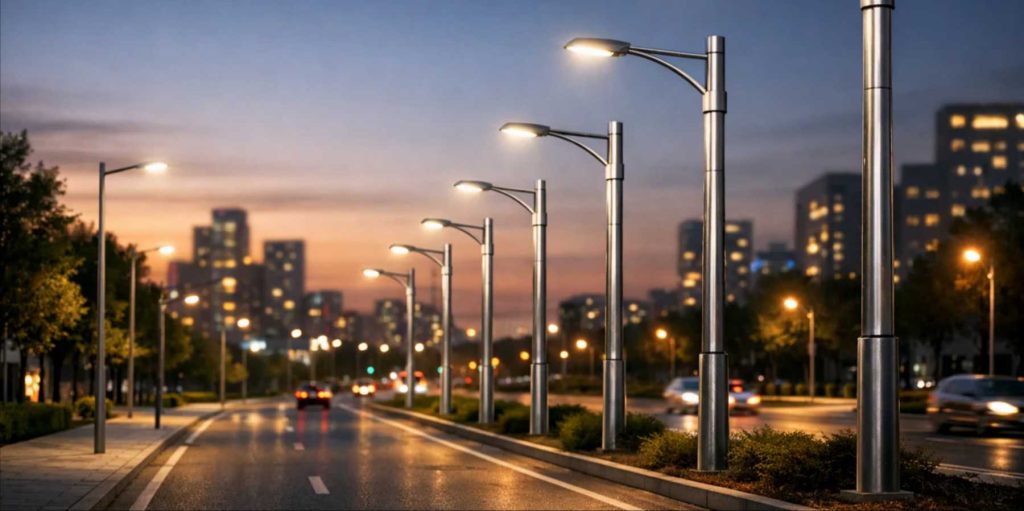
Pole Height Impact
Spacing cannot be calculated purely by empirical height-multiple geometric rules. Final layout validation follows the IES RP-8 roadway lumen method, derived from average pavement illuminance calculation.
- CU (Coefficient of Utilization): Efficiency of the luminaire optics.
- LLF (Light Loss Factor): Accounting for dirt accumulation and LED lumen depreciation (LM-80/TM-21 data).
Structural Mounting Height Classifications (BS EN 40 / AASHTO compliant)
- 3.0m to 4.5m (10 to 15 ft): Pedestrian scales, greenways, residential pathways. Target illuminance: 5 to 10 Lux.
- 6.0m to 7.5m (20 to 25 ft): Urban residential streets, local roads, small commercial parking perimeters. Target illuminance: 10 to 15 Lux.
- 9.0m to 10.5m (30 to 35 ft): Commercial centers, industrial parks, collector streets. Target illuminance: 15 to 30 Lux.
- 12.0m to 14.0m (40 to 45 ft): Expressways, major highway interchanges, industrial freight terminals. Target illuminance: 30+ Lux.
Light Distribution Types
Light distribution types change how far apart poles can be. Each type makes a different light pattern. This changes how installers set up the poles. For example, Type II is best for narrow roads. Type V works well in big open spaces. The table below shows how each type affects layout and spacing:
| Light Distribution Type | Description | Applications | Ideal Mounting Height |
|---|---|---|---|
| Type II | 25° lateral spread | Narrow roads, edges | Width should be less than 1.75 times height |
| Type III | 40° lateral spread | Parking lots | Width should be less than 2.75 times height |
| Type IV | 60° half-circle spread | Wide roads, site edges | Width should be less than 3.7 times height |
| Type V | 360° circle spread | Center poles, intersections | N/A |
Installers use these rules to get the best spacing and even light. Morelux Steel Poles can be made for each light pattern. They work with led and solar street lighting.
Lumen Output & Fixture Type
Lumen output and fixture type decide how much area gets lit. Fixtures with more lumens can be spaced farther apart. Fixtures with fewer lumens need to be closer together. For example, a led fixture with 20,000 lumens on a 25-foot pole lights a bigger area than on a 15-foot pole. The optics type, like Type III or Type V, also changes the setup. Installers must pick the right fixture and lumen output for the area. This keeps the lighting even and saves energy. Morelux has many led and solar street lighting fixtures. Manufacturers and wholesalers can choose the best one for each job.
Area Use & Application
How the area is used changes pole spacing and layout. Homes, parking lots, and highways all need different spacing for good light and safety. The table below shows the best pole spacing for common places:
| Pole Height | Recommended Spacing (ft) |
|---|---|
| 20 ft | 50 to 70 |
| 25 ft | 62 to 87 |
| 30 ft | 75 to 105 |
Parking lots often use wider spacing than streets. Installers must check the layout to stop dark spots. Morelux Steel Poles fit many outdoor uses, from small paths to big factories.
Layout Patterns
Layout patterns help installers arrange poles for even light. Common patterns are single row, double row, staggered, and square grid. The choice depends on the area’s shape and lighting needs. For example, staggered layouts give better light in parking lots. Single rows work well for narrow streets. The layout must match the light pattern and pole spacing rules. This gives the best results. Morelux’s factory can make custom poles for any layout. They support led and solar street lighting.
Standards & Codes
International standards give clear rules for pole spacing and layout. These rules help keep outdoor lighting safe, bright, and efficient. Some common rules are:
- For 3–4 meter roads (like paths): 3–4 meter poles, spaced 10–15 meters apart.
- For 5–7 meter roads (like country roads): 5–7 meter poles, spaced 15–25 meters apart.
- For 8–12 meter roads (like city streets): 8–10 meter poles, spaced 25–30 meters apart.
- For 20+ meter roads (like highways): 12–14 meter poles, spaced 40–50 meters apart.
Manufacturers and wholesalers use these rules to plan lighting projects. Morelux Steel Poles meet international codes like BS EN, AASHTO, and AS/NZS. This makes sure led and solar street lighting is safe and follows the rules.
Note: Following standards and using the right layout keeps pole spacing, energy use, and safety at their best in all outdoor spaces.
Light Pole Spacing Mistakes & Practices
Over-Spacing & Under-Spacing
Many projects have trouble when poles are too far apart or too close. If poles are spaced too far, dark spots can appear. These dark spots make it hard for people to see. This can cause accidents. If poles are too close, the area gets too bright. This can cause glare and waste energy. Both mistakes change how well the area is lit. They can make public safety worse. Installers should check the light coverage radius to stop these problems.
Common mistakes include:
- Adding lights to poles without checking the layout first
- Using fixtures that are too bright or not shielded well
- Light going in the wrong direction and causing glare or shining into homes
- Not enough support for new fixtures, which can cause accidents
Ignoring Standards
Not following lighting standards can cause big problems. If installers ignore rules, accidents and injuries can happen. Legal trouble may come next, like fines or lawsuits. Some projects get penalties over $13,000. Agencies can inspect and punish people who break rules again and again. Companies may lose contracts or even close their business. Following standards keeps people safe and makes sure lighting projects follow the rules.
Tips for Effective Coverage
Installers can use easy tips for better coverage:
- Space poles 2.5 to 3 times their height for even light
- Use taller poles for bigger areas to cover more space
- Put poles on both sides of wide streets in a balanced way
- Pick the right fixture type for each area
- Use Type V distribution in parking lots to cover more space
These tips help make light even, save energy, and keep people safe.
Quick Reference Table
This integrated reference table complies with AS/NZS 1158 and IES RP-8 standards, providing contractors and designers with one-click parameter reference for mainstream outdoor lighting projects:
| Application Type | Typical Pole Height (ft) | Recommended Spacing (ft) | Typical Lumen Range (lm) | Best For |
|---|---|---|---|---|
| Footpaths & Walkways | 12-20 | 30-50 | 12,000-20,000 | Pedestrian safety, parks, residential |
| Residential Streets | 20-25 | 50-70 | 20,000-30,000 | Neighborhoods, small parking lots |
| Commercial Parking Lots | 25-30 | 60-80 | 25,000-45,000 | Retail, offices, large parking areas |
| Industrial Facilities | 30-40 | 80-120 | 40,000-60,000 | Factories, campuses, wide open spaces |
| Highways & Arterials | 35-45 | 100-150 | 50,000-70,000 | Main roads, expressways, large intersections |
Scientific pole spacing eliminates dark zones and glare overlap, improving traffic and pedestrian safety while optimizing long-term energy consumption. All design parameters in this guide are aligned with international roadway and outdoor lighting codes to ensure project legality, safety, and durability.
Good light pole spacing helps people see better and stay safe. It lowers the chance of accidents and cuts down on dark spots. Using strong products like Morelux Steel Poles makes sure the poles last a long time. Planners need to use the right rules and standards. If they have special needs, they can ask Morelux’s technical support for help.
- Makes it easier to see and follow rules
- Follows international standards
FAQ
How does pole height affect lighting coverage?
Pole height affects the illuminated area. Tall poles can illuminate a larger space. Short poles need to be spaced closer together to ensure uniform lighting.
What standards guide pole spacing?
Installers follow standards such as BS EN, AASHTO, and AS/NZS. These standards ensure safe and effective lighting.
Can Morelux steel poles be customized for different projects?
Morelux allows you to choose pole height, installation method, and finish. They are suitable for a variety of lighting and project needs.